JunPus thermal compounds deliver advanced heat dissipation solutions tailored for high-performance AI chips, CPUs, GPUs, and 5G base stations.
Engineered for cutting-edge semiconductor technologies,
our patented thermal pastes optimize thermal conductivity, ensuring stable performance under intensive workloads. Trusted across electronics, data centers, and telecommunications
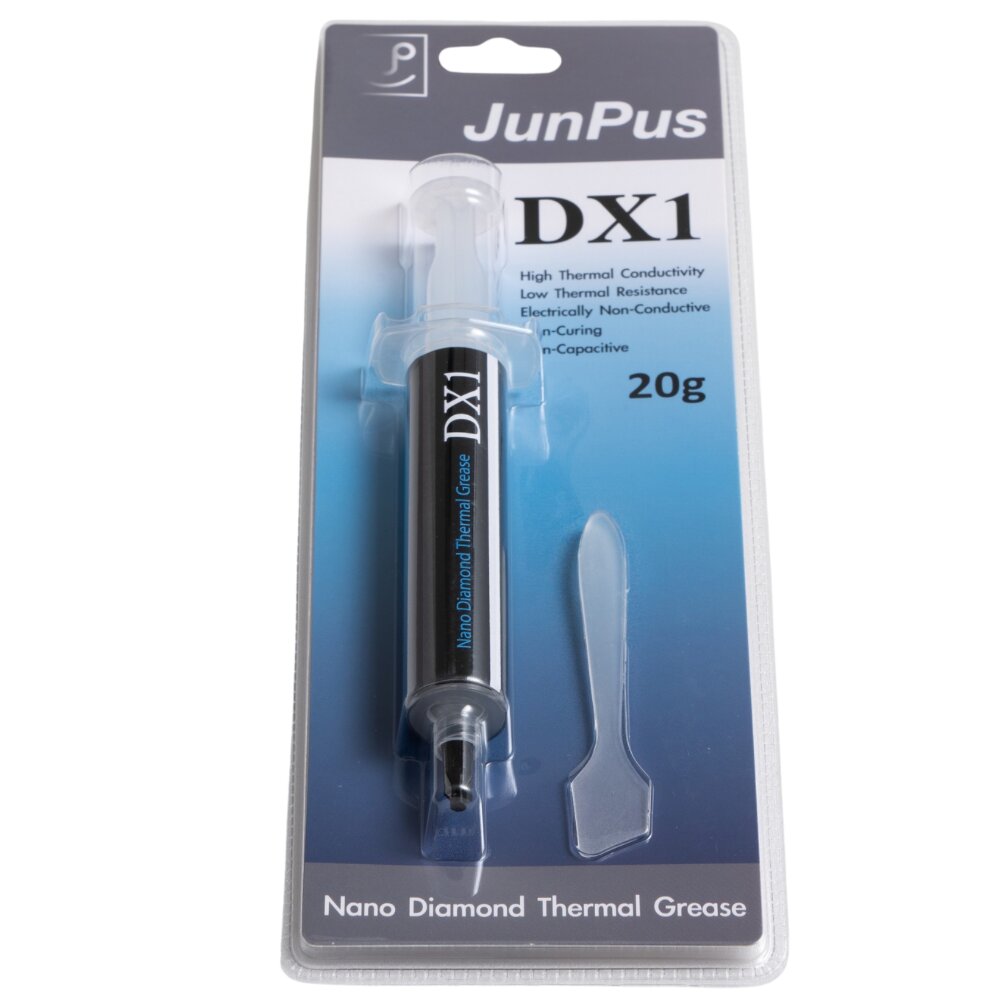
A carefully applied thermal interface is an important part of CPU assembly. JunPus JP-DX1 brings nanodiamond thermal paste to this step, combining a nanodiamond and silicone formulation with handling features suited to hands-on installation.
JunPus JP-DX1 thermal paste, 20 g. Original product photograph from the JunPus website.
For PC builders, technicians and assembly teams, it offers a practical way to prepare the contact between a processor and its heatsink.
Recent CPU developments and assembly decisions
Intel’s October 6, 2026 CPU throughput article examines the work a platform completes across agent workflows. Its test replayed recorded tasks for an hour, without live model inference or network access. The useful lesson for builders is to evaluate a defined workload over time and keep the test conditions with the result.
AMD’s September 23 discussion of Zen architecture describes trade-offs among performance, frequency, silicon area and power, including the roles of chiplets and different core configurations. That context helps explain why a processor’s model and intended workload matter when planning a cooling assembly.
For a concrete desktop reference, Intel’s March 11 Core Ultra 200S Plus announcement lists 24 cores for the Core Ultra 7 270K Plus, split between eight P-cores and 16 E-cores. This is earlier 2026 platform background. It gives builders a specific configuration to investigate alongside the appropriate motherboard, cooler and installation instructions.
These vendor references describe processor platforms. For a JP-DX1 evaluation, document the actual hardware and application method rather than infer paste performance from a processor specification or benchmark.
Where CPU thermal paste fits
Even closely fitted metal surfaces have microscopic imperfections. Thermal interface material occupies these small gaps between the processor’s integrated heat spreader and the cooler’s contact surface, supporting heat transfer across the interface. Correct preparation and installation help this essential part of the cooling assembly do its job. [3]
JP-DX1 is formulated with nanodiamond powder and silicone fluids. JunPus identifies it as a thermal compound for high-performance electronics. Its role in CPU assembly is to provide the thermal interface between the processor and heatsink, making material selection and careful application part of the same installation process.
JP-DX1 application and handling
JP-DX1’s application characteristics are a useful part of its appeal. Ainex describes the paste as easy to spread and supplies its Japanese retail version in a syringe with an application spatula. That format gives installers a straightforward sequence: dispense the material, spread it across the intended contact area and prepare the cooler for mounting. [2]
Ainex also identifies JP-DX1 as electrically non-conductive. Together with its spreadable consistency, this is a relevant material characteristic for teams selecting a thermal paste for electronic assemblies. The focus is on a manageable application step that fits naturally into a careful CPU installation. [2]
For production planning, JunPus also lists compatibility with precision printing and coating processes. Teams can consider how JP-DX1 fits their intended application method, alongside the geometry of the interface and the requirements of the finished assembly.
CPU thermal paste installation checks
Begin with clean contact surfaces and follow the CPU and cooler manufacturers’ installation instructions. Remove used thermal material before reapplication, and do not add paste over an existing pre-applied interface. Confirm the appropriate amount, coverage and mounting method for the selected hardware, then evaluate the assembled system under its intended workload. [4]
JP-DX1 pairs a nanodiamond-based formulation with practical application options. From desktop builds to assembly-process evaluation, its handling features provide a useful starting point for integrating thermal paste into a well-prepared cooling workflow.
For package options and CPU-interface evaluation requirements, contact JunPus with your processor, cooler and intended application method.